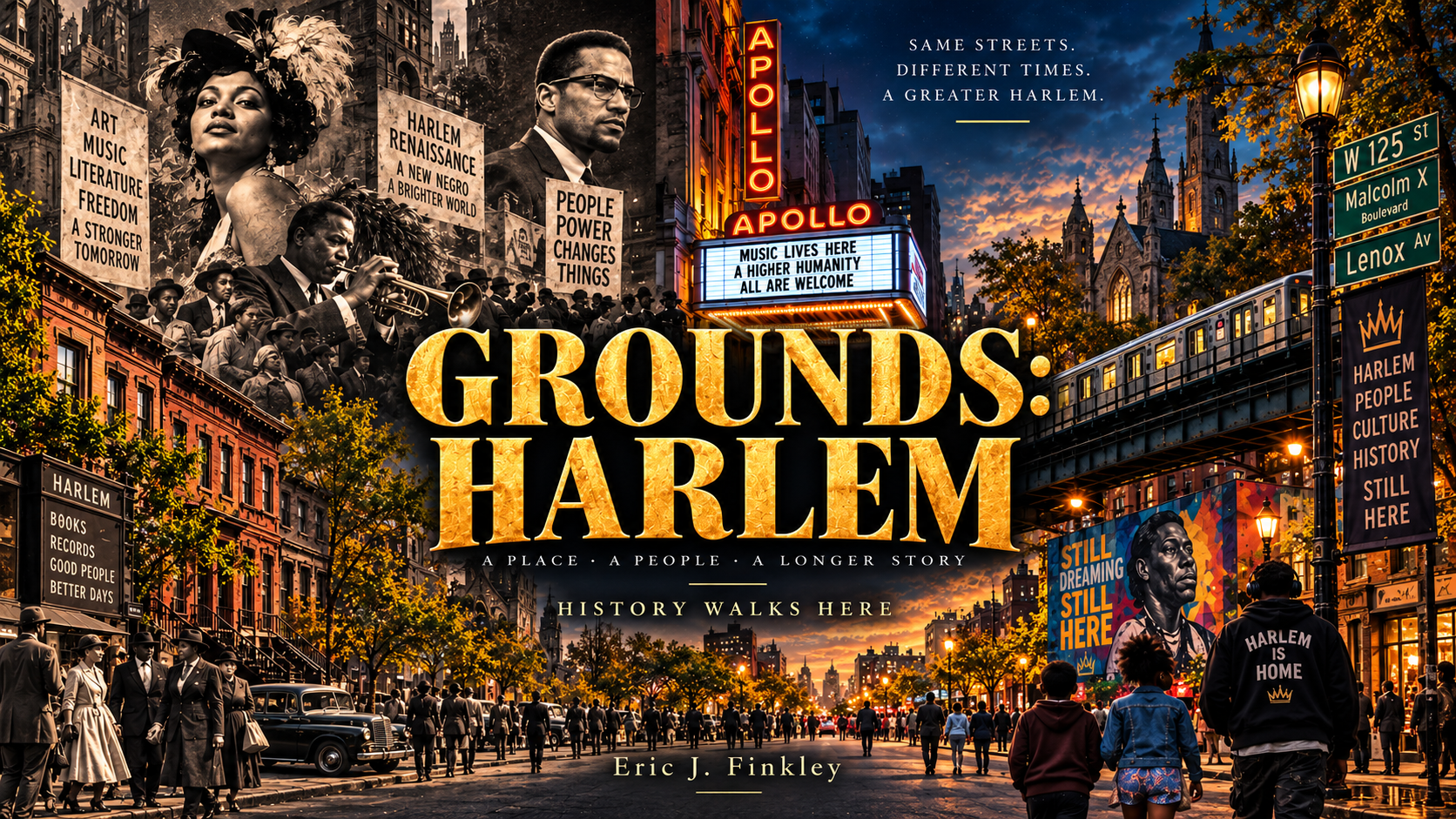
GROUNDS: Harlem
A Place. A People. A Longer Story.
Harlem was Harlem before America figured out what it wanted Harlem to mean. Before the Apollo lights, before Malcolm, before the Harlem Renaissance became history, the Ground was already changing — through migration, housing, transit, culture, politics, business, disinvestment, survival, reinvestment, and memory.
GROUNDS: Harlem follows the neighborhood across generations, from its earlier land and transit history through the Great Migration, the Harlem Renaissance, 125th Street, the Apollo, Black political power, the drug era, fashion, redevelopment, gentrification, and the living Harlem of today. The book treats the neighborhood not as a backdrop for famous names but as a place with its own systems, pressures, routes, institutions, blocks, businesses, and memory.
The story moves between documented history and lived observation. Eric J. Finkley writes from connection, not claim: Harlem is not presented as a single community with one voice, and the book does not flatten competing experiences into one clean narrative. The point is to keep the Ground visible — who built on it, who moved through it, who was displaced from it, who protected it, who profited from it, and who kept making culture there.
This is not postcard Harlem and not a classroom summary. It is Harlem as place, evidence, argument, and inheritance: lived, argued over, built, broken, protected, bought, remembered, and remade. History walks here.